
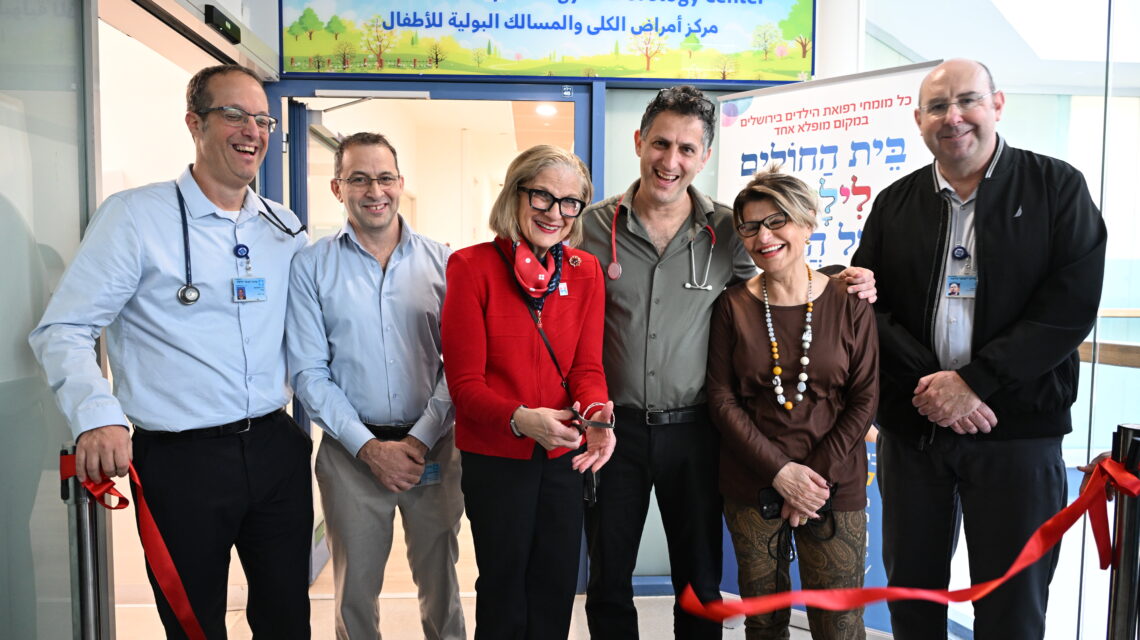
The ribbon was cut Wednesday (Feb. 11) on Israel’s first combined Pediatric Nephrology- Urology center at Hadassah Medical Organization’s Ein Kerem hospital. For the first time in Israel, all medical responses to kidney diseases and urinary tract diseases in children will be consolidated in the soon-to-be-opened single center.
The center’s establishment reflects a profound change in approach in pediatric medicine, away from domain-focused treatment to integrative care. This sees the child as a complete person, rather than as a collection of separate systems.
The new center closely connects two complementary medical fields: pediatric nephrology, which deals with the diagnosis and treatment of kidney diseases, and pediatric urology, which focuses on surgical and medical treatment of urinary tract diseases and malformations. The connection between the fields is not only technical, but is based on a comprehensive clinical vision, which is especially required in complex medical situations in which there is a mutual influence between kidney function and the structure and activity of the urinary tract.
“I’m honored to be here with all of you to celebrate the inauguration of the Pediatric Nephrology Urology Center,” said Carol Ann Schwartz, National President of Hadassah Women’s Zionist Organization of America and head of the global Hadassah movement. “Taking care of our kidneys is extremely important. It affected me personally when I was three years old.”
Located on the seventh floor of Ein Kerem’s Charlotte Bloomberg Mother and Child Building, the center includes a dedicated clinic and procedure rooms. There will be joint clinics for children suffering from urological problems accompanied by damaged or decreased kidney function. In a unique clinic, urinary tract stones in children will be treated. This requires expertise and age-appropriate adaptation.
The establishment of the center is the result of close collaboration and a shared medical vision between Dr. Oded Volovelsky, Director of the Pediatric Nephrology Unit who is also President of the Israeli Association for Pediatric Nephrology, and Prof. Guy Hidas, Director of the Pediatric Urology Unit and who is President of the Israeli Pediatric Urology Society.
“The underlying vision is to create a single, clear medical address that prevents fragmentation among different clinics, and to enable shared, informed decision-making right from the diagnosis stage,” says Prof. Hidas. “The new model reduces emotional and logistical burden on families, and shortens medical processes that previously required complex coordination among various factors.”
“The uniqueness of the Pediatric Nephrology-Urology Center lies not only in the professional combination of nephrology and urology, but also in the broad multidisciplinary framework that accompanies the medical treatment,” says Dr. Volovelsky.
Alongside the senior doctors and dedicated liaison nurses, a clinical dietitian specializing in renal nutrition, a clinical pharmacist, a psychosocial team, and a school staff for children are integrated into the system. The facility will also include a personalized, multidisciplinary clinic for Urination Disorders and Sphincter Control, coordinated by Dr. Leonid Boyarsky, who trained at the Wilhelmina Children’s Hospital in Utrecht, Netherlands, one of the world’s leading centers in the field.