
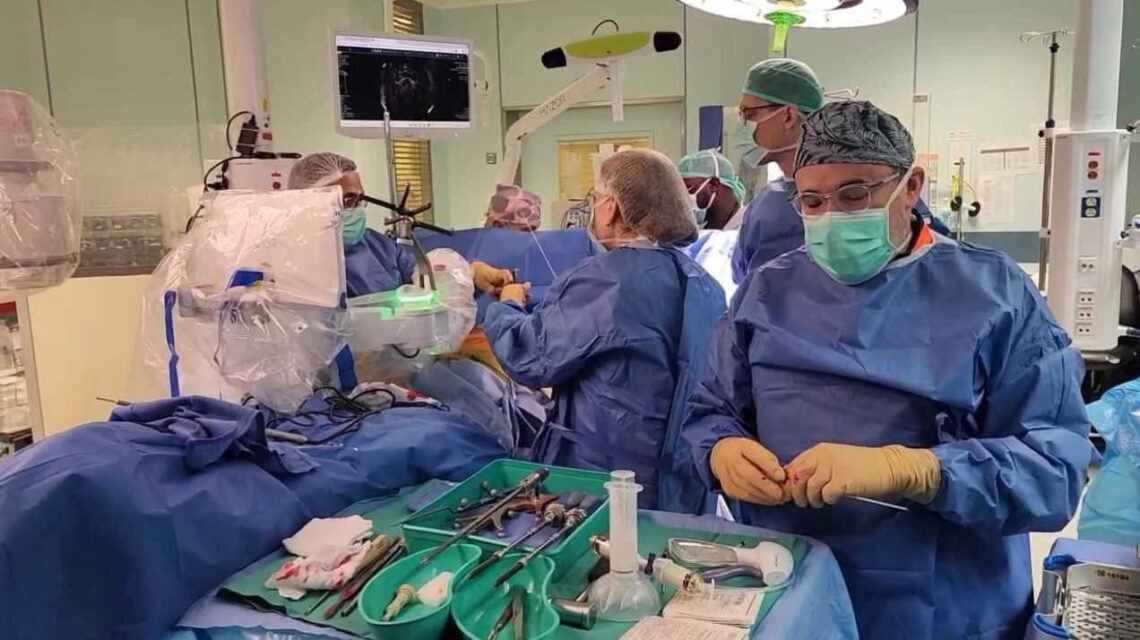
A 70-Year-Old Woman Undergoes Complex Robotic Surgery While Awake, to the Sound of Hasidic Music.
The procedure was successfully completed, allowing the patient to celebrate the Passover Seder night while recovering from a severe injury.
The patient, who suffered a fracture of the sacrum (pelvic bone), underwent urgent surgery on the eve of the holiday at Hadassah Ein Kerem. The life-saving procedure was performed by an orthopedic surgical team using robotic technology.
“This is a patient who had been in severe pain and bedridden for an entire month after falling and fracturing her sacrum,” explains Prof. Josh Schroeder, Head of the Spine Surgery Unit at Hadassah. “Any movement or bending was impossible, leading to a significant decline in her quality of life and intense pain. She also developed a serious case of pneumonia, which worsened due to prolonged immobility, including aspiration (inhalation into the airways) of food or liquids, a major risk factor for long-term lung damage and a life-threatening condition.”
The patient’s family approached Prof. Schroeder to perform the surgery urgently ahead of the holiday.
“I understood the concern of her son, who simply wanted his mother to be able to get out of bed after a month of complete immobility and deteriorating health, and to experience the holiday differently,” says Prof. Schroeder. “When we arrived on Wednesday afternoon, just before the holiday, and consulted with our anesthesiologist, Dr. Hashem Ruhi, it became clear that she could not undergo general anesthesia, as it would have put her life at risk due to her severe pneumonia.”
After careful deliberation, the team decided to perform sacral fixation surgery under local (spinal) anesthesia.
“This is a highly unusual decision for this type of procedure,” emphasizes Prof. Schroeder. “Spinal anesthesia is a regional technique in which anesthetic medication is injected into the spinal fluid in the lower back. It temporarily numbs the lower half of the body while allowing the patient to remain fully awake. It is rarely used in major pelvic surgeries, but any other form of anesthesia would have endangered her life.”
The surgery was performed by a multidisciplinary team including anesthesiologist Dr. Hashem Ruhi, Dr. Ahmed Shawan, and operating room nurses Mohammad Karain and Lili Osipov, using the “Mazor” robotic system, an Israeli-developed technology routinely used in Hadassah’s orthopedic operating rooms.
“Thanks to this approach, the entire procedure was completed in just 20 minutes, whereas a standard non-robotic surgery would typically take several hours,” explains Prof. Schroeder.
“That very evening, the patient was already showing improvement in her pneumonia, was able to sit up in bed for the first time in the intensive care unit, and experienced the Passover Seder in a way she never believed possible,” he concludes. “Her family thanked us for what they called a true miracle, arriving just in time for Passover.”
Photo: The surgical team in the operating room.